Is Cream of Mushroom Soup Safe for Dogs?
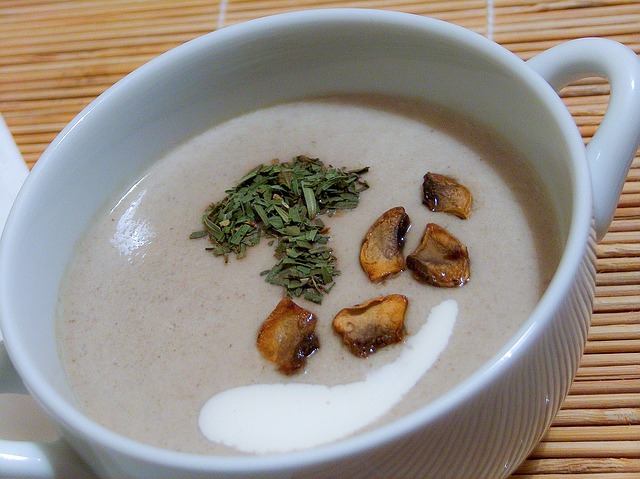
Cream of mushroom soup isn’t safe to feed to dogs. The concern isn’t the mushrooms — the edible varieties used in commercial soups are the same ones that are fine for people, and plain cooked mushrooms aren’t an issue for dogs. The concern is the rest of the ingredient list: very high sodium, dairy, and — in standard canned varieties — dried garlic.
It’s not a food that demands an emergency response if your dog lapped up a small splash. But it’s also not one to offer deliberately, and a dog that gets into a significant amount — particularly a small dog or one with existing health conditions — warrants a call to the vet.
What’s Actually in Cream of Mushroom Soup
Before getting to the risks, it’s worth looking at what’s actually on the label, because the picture is often misrepresented online. The standard Campbell’s Condensed Cream of Mushroom Soup ingredient list reads:
Water, mushrooms, vegetable oil (corn, canola, and/or soybean), modified cornstarch, wheat flour, salt, cream, whey, soy protein concentrate, monosodium glutamate, yeast extract, dried garlic, natural flavoring.
A few things stand out:
- Onion is not present in the standard product. Many pet-safety articles list onion as an ingredient in cream of mushroom soup — this is incorrect for the standard Campbell’s condensed variety. It’s a factual error repeated widely online, likely because some variants (such as the Roasted Garlic variety) do contain additional allium ingredients, but the standard formula doesn’t include onion.
- Dried garlic is present, listed near the end — which means only a small quantity, but garlic is toxic to dogs at sufficient doses, and it belongs on the list of concerns.
- Cream and whey are both dairy products, which can cause digestive upset in dogs with lactose sensitivity.
- Salt is the sixth ingredient, and the sodium figures reflect its prominence.
Homemade versions are a different matter — many recipes call for whole onion, substantial garlic, butter, and cream, which raises the risk profile considerably compared to the canned product.
Why Cream of Mushroom Soup Is a Problem for Dogs
There are three distinct concerns, at different levels of seriousness.
Sodium — the main issue. One half-cup serving of condensed Campbell’s Cream of Mushroom Soup contains 860 mg of sodium. The full 10.5 oz can contains roughly 2,150 mg total. That is a very high sodium load for a dog. Too much salt too quickly can cause a condition called hypernatremia — rising blood sodium that pulls water out of the body’s cells and, in serious cases, affects the nervous system.
Garlic — real but small-quantity risk. Garlic belongs to the allium family and is toxic to dogs, causing oxidative damage to red blood cells that can lead to hemolytic anemia. The threshold is not precisely established. Working from Merck’s published figures — garlic is approximately 3–5 times more toxic per gram than raw onion, against an onion baseline of 15–30 g/kg — the implied garlic range is roughly 3–10 g/kg. But a more conservative onion baseline of ~5 g/kg (0.5% of body weight), also cited in veterinary literature as a precautionary lower floor, implies garlic concern starting nearer ~1 g/kg. The realistic concern range therefore spans roughly 1–10 g/kg, not a single well-defined number. The quantity of dried garlic in a standard can of soup is unlikely to cause acute garlic toxicity in a single serving for a medium or large dog — but the margin is narrower for small dogs, and allium toxicity can be cumulative: trace garlic being non-toxic in one serving does not make this soup safe to feed regularly.
Dairy — a digestive concern, not a toxicity issue. Cream and whey contain lactose. Most adult dogs have reduced lactase activity and can experience vomiting, diarrhoea, and stomach discomfort from dairy. This varies considerably between individual dogs; some tolerate small amounts without trouble, others don’t.
How Much Is Actually Dangerous?
The honest picture is that cream of mushroom soup is unlikely to cause acute poisoning from a small spill or lick. But understanding where the real thresholds sit is more useful than a blanket warning.
For sodium: The Merck Veterinary Manual puts the threshold for clinical signs at roughly 2–3 grams of salt per kilogram of body weight, with around 4 grams per kilogram being potentially life-threatening. An important note on units: these figures are for salt (sodium chloride), not sodium — and salt weighs about 2.5 times its sodium content, so the two figures aren’t interchangeable.
Translating that to the soup: the full 10.5 oz can contains approximately 5.5 grams of salt-equivalent (2,150 mg sodium converted to NaCl). For a 20 lb (9 kg) dog, the threshold for clinical signs from salt alone is around 18–27 grams — meaning even a full can sits well below acutely toxic territory. For a small 10 lb (4.5 kg) dog, the threshold is roughly 9–14 grams — the full can’s ~5.5 g salt-equivalent represents more than half of the lower clinical threshold for a dog that size. That is still technically below the toxic range, but it is a substantial sodium load, and sodium is the lead hazard in any realistic scenario involving this soup, including for small dogs. For very small dogs, puppies, and dogs with heart or kidney disease, the gap between the soup’s sodium content and a problematic dose is not large.
For garlic: Working from the ingredient list position, the can likely contains roughly 0.2–1 g of dried garlic, equivalent to perhaps 1–5 g of fresh garlic. Against the upper end of the concern range (3–10 g/kg), a medium or large dog’s threshold is comfortably above this. Against the conservative lower floor (~1 g/kg), a 10 lb (4.5 kg) dog’s threshold is around 4.5 g — meaning the upper estimate of the can’s garlic content approaches, though does not clearly exceed, that margin. For a medium or large dog, the garlic in a single can is unlikely to cause acute allium toxicity. For a small dog, garlic is a secondary reason to be cautious — sodium remains the more immediate and larger hazard, but garlic adds to it rather than being dismissible.
The situations that do warrant concern: a very small dog or puppy eating a significant portion of a can, a dog with pre-existing heart or kidney disease (for whom any sodium spike matters), or a dog that ate a homemade version with whole onion and substantial garlic.
What To Do If Your Dog Ate Cream of Mushroom Soup
If your dog got into cream of mushroom soup:
- Note the amount and the time. Even a rough estimate — a few licks versus most of a can — is the most useful information you can give a vet.
- Make sure fresh water is freely available. Don’t restrict water, and don’t try to force large amounts either — just keep a normal bowl accessible.
- Do not try to induce vomiting unless a vet specifically instructs you to.
- Call your vet or an animal poison line if the amount was large, if your dog is small, or if your dog has a heart or kidney condition. In the US, the Pet Poison Helpline is (855) 764-7661 (note: a per-incident fee applies, currently around $89). Outside the US, contact your vet or your country’s nearest animal poison service.
- Monitor over the next several hours for signs of sodium upset, and over the following few days if garlic exposure was significant.
A dog that licked a few drops off the floor: monitor and move on. A small dog that ate a large portion: call for advice without delay.
Signs to Watch For
Early signs of sodium-related upset (can appear within hours of a large ingestion):
- Vomiting
- Diarrhoea
- Excessive thirst and urination
- Lethargy
More serious sodium-related signs — seek veterinary attention promptly:
- Tremors or muscle stiffness
- Loss of coordination or disorientation
- Seizures
- Collapse
Signs associated with garlic toxicity (typically appearing 3–5 days after significant exposure — not immediately):
- Lethargy and weakness
- Pale, yellowish, or greyish gums
- Reduced appetite
- Rapid or laboured breathing
- Dark or reddish-tinged urine
The delayed onset of garlic-related signs is important: if your dog consumed a garlic-containing food and develops these symptoms within a week, tell your vet and make the connection explicitly.
What About Homemade Cream of Mushroom Soup?
Homemade versions vary entirely depending on the recipe. Many include whole onion or significant garlic alongside butter, cream, and salt — a considerably higher allium and sodium load than the standard canned product.
If your homemade recipe included onion or garlic, treat any significant ingestion as a more serious allium exposure. The onion and garlic pages — onions, garlic, and garlic powder — cover the mechanism and risk levels in more detail. Calling your vet is appropriate if your dog ate a meaningful serving of a recipe with these ingredients.
Other Canned Soups
Cream of mushroom soup isn’t unique in this regard — most canned and condensed soups are high in sodium and frequently contain allium ingredients. If your dog tends to investigate the kitchen counter, it’s worth reading about canned soup generally and minestrone soup, which typically contains onion and garlic in more prominent quantities.
Safer Ways to Add Flavour
If you want to add moisture or flavour to your dog’s food without the sodium and garlic load, better options include:
- Low-sodium or unsalted chicken broth or beef broth — check the label specifically for the absence of onion, garlic, and added salt
- Plain cooked mushrooms with no seasoning, oil, or sauce — the edible varieties used in cooking are generally fine for dogs in plain form
- Plain cooked meat with no marinade, seasoning, or sauce
Frequently Asked Questions
This FAQ summarises general veterinary guidance. It’s informational only and not a substitute for advice from your own vet, who knows your dog.
Is cream of mushroom soup toxic to dogs?
Not in the way that chocolate or grapes are acutely toxic. The main concerns are high sodium, a small amount of dried garlic, and dairy — none of which cause instant poisoning from a small taste. The risk scales with the quantity eaten and with the size and health of your dog. A few licks is very unlikely to cause harm in a healthy adult dog; a full can eaten by a small dog is worth a vet call.
Does cream of mushroom soup contain onion?
The standard Campbell’s Condensed Cream of Mushroom Soup does not contain onion. Many pet-safety articles incorrectly list onion as an ingredient — it isn’t on the standard label. Dried garlic is present. Some variants (such as the Roasted Garlic variety) may contain additional garlic or different allium ingredients, so always read the specific product label.
Can my dog eat plain mushrooms?
Yes — the edible varieties used in cooking (button, cremini, portobello, shiitake) are generally safe for dogs when plain, cooked, and unseasoned. The concern with cream of mushroom soup isn’t the mushrooms; it’s the sodium, garlic, and dairy. See our mushrooms page for more detail.
My dog ate a whole can — what should I do?
Note your dog’s weight and the approximate amount consumed, then call your vet or the Pet Poison Helpline. The sodium from a full can is unlikely to cause acute poisoning in a medium or large healthy dog, but it’s a large enough load that a phone call is worthwhile — particularly for small dogs (under 10 lbs), puppies, and dogs with known heart or kidney conditions.
What about low-sodium cream of mushroom soup?
Lower-sodium versions reduce the main concern to some degree, but still contain dairy and garlic. The principle remains the same: it’s not an appropriate food for dogs, and there’s no nutritional reason to include it in their diet.
About This Guide
This guide was researched and written by Claire Donnelly for Is It Safe For My Dog?. We are not veterinarians. Each guide is compiled from published, publicly accessible veterinary and toxicology sources — for this page, the ASPCA, the Pet Poison Helpline, the Merck Veterinary Manual, and Campbell’s official ingredient information — and the specific figures are cross-checked against more than one source before publication. Where sources disagree, we say so. This is general information to help you make an informed decision; it does not replace a consultation with your own vet, who can account for your individual dog’s size, age, and health.
Sources for the figures on this page
- Merck Veterinary Manual — Garlic and Onion (Allium spp) Toxicosis in Animals (allium toxic dose thresholds and garlic-to-onion potency ratio)
- Merck Veterinary Manual — Salt Toxicosis in Animals (toxic and lethal salt dose thresholds)
- ASPCA Animal Poison Control — People Foods to Avoid Feeding Your Pets
- Pet Poison Helpline — Salt / Sodium
- Campbell’s — Condensed Cream of Mushroom Soup ingredient label (verified via campbells.com)
This page is informational only and does not constitute veterinary or medical advice. If you are worried about your dog, contact your vet or a local animal poison service.