Are Onions Safe for Dogs?
No. Onions are genuinely toxic to dogs, and this is one of the cases where the popular “toxic” label is exactly right — not overstated.
That distinction matters on this site. We push back when the internet overstates a risk — oregano, lemon, and avocado are all foods whose “toxic to dogs” reputation is louder than the evidence supports. Onions are the opposite: a real, well-documented blood toxin with an established dose threshold, a known mechanism, and a delayed, easy-to-miss onset. When we say onions are toxic, we mean it in the strict sense.
All forms are toxic — raw, cooked, dehydrated, and powdered — and cooking does not reduce the hazard. Onion powder, because it’s concentrated, is one of the most common and most underestimated exposure routes.
This page is the site’s full reference for allium toxicity; the garlic, green onions, leeks, and chives pages share the same mechanism and point here for the detail.
How Onions Poison Dogs — the Mechanism
Onions contain sulfur compounds — principally n-propyl disulfide and related thiosulphates — that dogs cannot safely process. Once absorbed, these cause oxidative damage to the membranes of red blood cells. In plain language:
- The onion compounds oxidise (chemically damage) the red blood cells.
- The damaged haemoglobin clumps into structures called Heinz bodies (Merck Veterinary Manual).
- The dog’s spleen recognises these damaged cells as defective and removes them — or the cells rupture on their own.
- Red cells are destroyed faster than the body can replace them. The result is haemolytic anaemia — too few working red blood cells to carry oxygen.
Because the damage accumulates as the compounds circulate, the serious sign — the anaemia — is delayed. A dog can eat onion today and look normal tomorrow, with the anaemia only becoming apparent several days later.
How Much Onion Is Toxic? The Dose Math
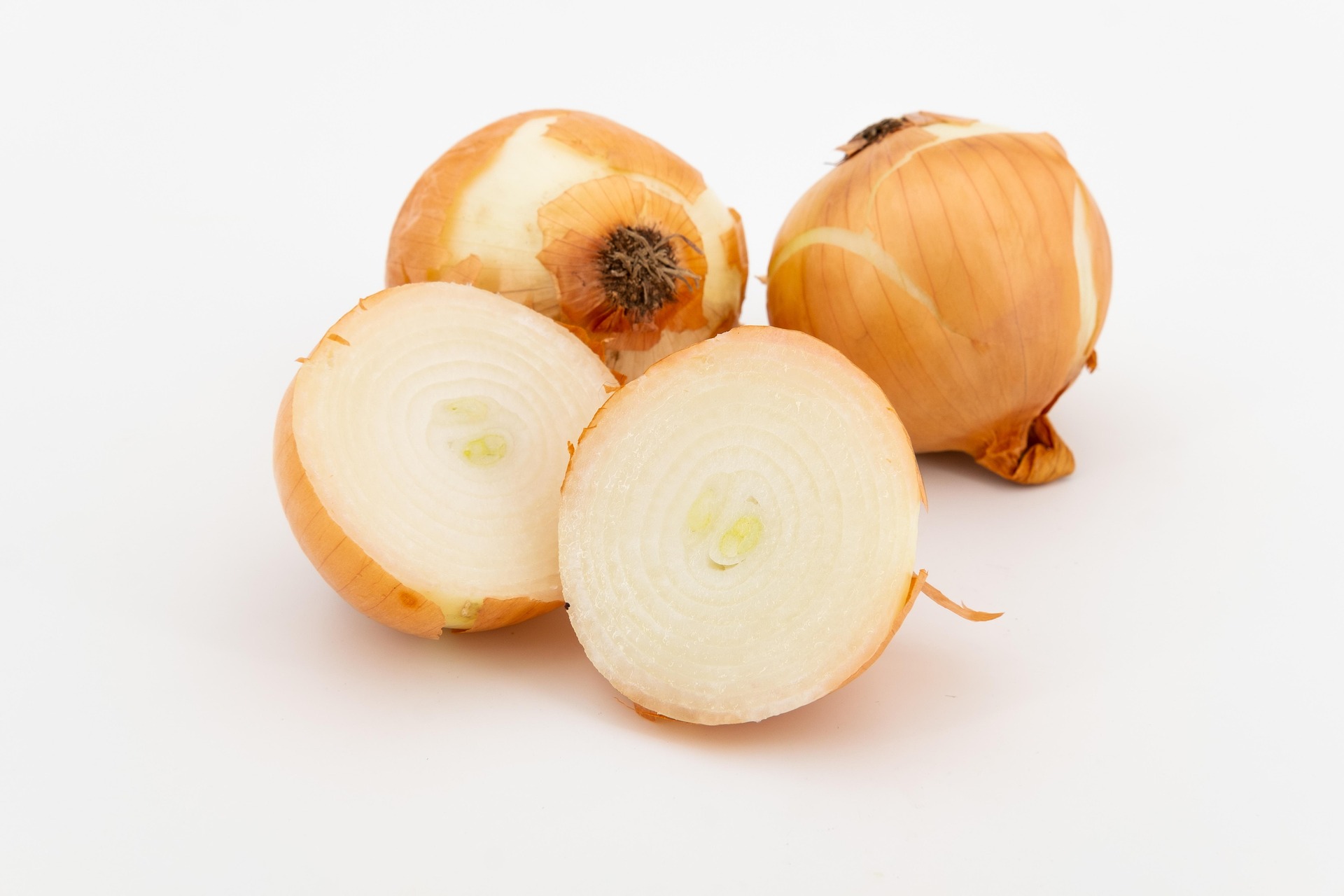
The Merck Veterinary Manual places the threshold for clinical onion toxicosis at approximately 15–30 grams of onion per kilogram of body weight. A medium onion weighs roughly 110 g.
Two cautions before the table:
- These are clinical-illness thresholds, not “safe below this” lines. Smaller amounts still cause measurable red-blood-cell damage, and because the effect is cumulative, repeated small exposures add up. There is no established safe dose of onion for dogs.
- Smaller dogs reach the threshold with alarmingly little onion.
| Dog weight | ~15 g/kg (lower) | ~30 g/kg (upper) | Rough onion equivalent |
|---|---|---|---|
| 5 kg (11 lb) | ~75 g | ~150 g | ~⅔–1½ medium onions |
| 10 kg (22 lb) | ~150 g | ~300 g | ~1½–3 medium onions |
| 20 kg (44 lb) | ~300 g | ~600 g | ~3–5 medium onions |
| 30 kg (66 lb) | ~450 g | ~900 g | ~4–8 medium onions |
The practical takeaway: a small dog that eats a portion of an onion-rich dish — a bowl of onion soup, a serving of onion-heavy stir-fry, a burger with a thick slice — can plausibly reach a concerning dose. A large dog needs more, but “more” is still an everyday quantity, not a sackful.
Every Form Counts — and Powder Counts Most
Cooking, drying, and processing do not destroy the toxic compounds. So all of these carry the hazard:
- Raw onion — in salads, on burgers, in salsa and guacamole
- Cooked onion — soups, stews, gravies, stir-fries, curries, and countless prepared dishes
- Dehydrated / dried onion — flakes and minced dried onion
- Onion powder — the concentrated form, and the most easily overlooked
Why powder is the sharpest risk: dried and powdered allium is far more concentrated per gram than the fresh vegetable, so a small amount of powder represents a large amount of onion. Onion powder hides in an enormous range of everyday foods — gravy granules, stock cubes and broths, crisps and savoury snacks, seasoning blends, spice mixes, many sauces, and processed meats. A dog that gets into a spice jar or a bag of onion-heavy snacks can take in more allium than one eating a slice of raw onion.
Where Dogs Actually Encounter Onion
Roughly in order of how often they cause trouble:
- Table scraps and shared leftovers — the single most common route; most savoury human cooking contains onion.
- Cooked dishes — soups, stews, casseroles, stir-fries, curries, pasta sauces, gravies.
- Raw onion — dropped from a chopping board, in a salad, on a snatched burger.
- Onion powder in seasonings and snacks — the concentrated, high-dose route.
- Baby food and prepared meals — many contain onion powder; a surprisingly common source for dogs fed human food.
Symptoms to Watch For
Onion toxicity has a two-stage, delayed presentation — the most important thing to understand about it.
Early (hours after ingestion) — gastrointestinal:
- Vomiting
- Diarrhoea
- Drooling
- Abdominal pain
- Reduced appetite
Later (typically 3–5 days) — the anaemia:
- Lethargy and weakness
- Pale gums
- Rapid heart rate
- Rapid breathing or panting
- Reddish or brown urine (a hallmark sign — released haemoglobin passing in the urine)
- Collapse in severe cases
The gap between the two stages is the trap: a dog that had mild vomiting on day one and then seemed to recover can be developing serious anaemia by day three or four. The absence of early symptoms does not mean the dog is safe.
What To Do
If your dog has eaten onion in any form, in more than a trivial amount — call your vet or an animal poison line now. Don’t wait for symptoms; the delayed onset means waiting works against you, and early decontamination (if the ingestion was recent) is far more effective than treating established anaemia.
- Confirmed or suspected significant ingestion: Call your vet, the Pet Poison Helpline, or the ASPCA Animal Poison Control Center. Have the dog’s weight and an estimate of how much onion, in what form. Powder and concentrated forms warrant a lower threshold to call.
- Small dog, or any exposure to onion powder / concentrated onion: Treat as higher priority — dose-per-kilogram is what matters, and small dogs reach it fast.
- A tiny, incidental amount (a lick of gravy, a crumb of an onion-containing food) in a healthy large dog: lower concern, but note it and watch closely for 3–5 days. When in doubt, call — the poison lines exist for exactly this judgement.
- Do not induce vomiting at home unless a vet directs you to.
There’s no home remedy for allium toxicosis. Treatment is veterinary: decontamination when appropriate, supportive care, and in severe cases a blood transfusion for the anaemia.
A Note on Breed Sensitivity
Some dogs are more vulnerable than others. Japanese breeds — notably the Akita and Shiba Inu — carry an inherited red-blood-cell trait that makes their cells more susceptible to this kind of oxidative damage. For these breeds, a given amount of onion can do more harm than it would to a typical dog of the same size. If you have one, be especially strict about allium exposure.
Frequently Asked Questions
This FAQ summarises general veterinary toxicology guidance. It’s informational only and not a substitute for advice from your own vet, who knows your dog.
Is a small amount of onion really that dangerous?
It depends on the dog’s size and the amount, but onion is not a food where “a little is fine” is safe advice. Because the effect is cumulative and there’s no established safe dose, the honest guidance is to avoid deliberate onion feeding entirely and to treat any significant accidental ingestion as a reason to call your vet.
My dog ate onion yesterday and seems completely fine — are we clear?
Not necessarily. The dangerous part — the anaemia — is typically delayed 3–5 days. A normal-looking dog the next day is expected, not reassuring. Watch for lethargy, pale gums, and discoloured urine over that window, and call your vet if any appear.
Why do some commercial dog foods or treats seem to contain onion or garlic?
Reputable commercial dog foods don’t include toxic levels of allium. The confusion usually comes from trace flavourings far below any toxic threshold, or from garlic-marketing myths (addressed on the garlic page). It doesn’t make deliberately feeding onion safe — the dose is the whole issue.
Are cooked onions safer than raw?
No. Cooking does not break down the compounds responsible for the toxicity. Cooked onion in a stew or gravy is just as much a concern as raw.
What about onion powder — is that worse?
In effect, yes, gram for gram. Powder is concentrated, so a small measure represents a lot of onion. It’s also easy to overlook because it’s an invisible ingredient in so many seasonings, snacks, and prepared foods.
About This Guide
This guide was researched and written by Claire Donnelly for Is It Safe For My Dog?. We are not veterinarians. Each guide is compiled from published, publicly accessible veterinary and toxicology sources — for this page, the ASPCA, the Pet Poison Helpline, the Merck Veterinary Manual, and VCA Hospitals — and cross-checked before publication. This is general information to help you understand the risk; it does not replace a consultation with your vet, and any suspected allium ingestion warrants direct veterinary advice.
Sources for the figures on this page
- Merck Veterinary Manual — Garlic and Onion (Allium spp.) Toxicosis in Animals (clinical onion toxicosis at approximately 15–30 g/kg body weight; garlic 3–5× more toxic than onion; raw, cooked, dehydrated, and granulated forms all toxic; Heinz-body haemolytic anaemia mechanism; delayed onset of clinical signs)
- VCA Hospitals — Onion, Garlic, Chive, and Leek Toxicity in Dogs (all four allium foods named and classified toxic; oxidative damage to red-blood-cell membranes; symptom onset may take several days; clinical signs including pale gums, elevated heart rate, red-coloured urine)
- ASPCA Animal Poison Control — Onion (onion classified toxic to dogs; n-propyl disulfide and related organosulfur compounds as the damaging agents)
- Pet Poison Helpline — Onion (onion toxicity in dogs; cumulative effect of repeated exposures; red-blood-cell damage leading to anaemia)
- Onion weight reference — a medium onion ≈ 110 g, used to convert the g/kg thresholds into everyday onion equivalents; general food-composition data, not a veterinary source
This page is informational only and does not constitute veterinary or medical advice.